Dear Anthropic, Google, Microsoft, OpenAI: This Is the Healthcare Product We'd Buy Tomorrow.
It's not about the model, it's the workflows.

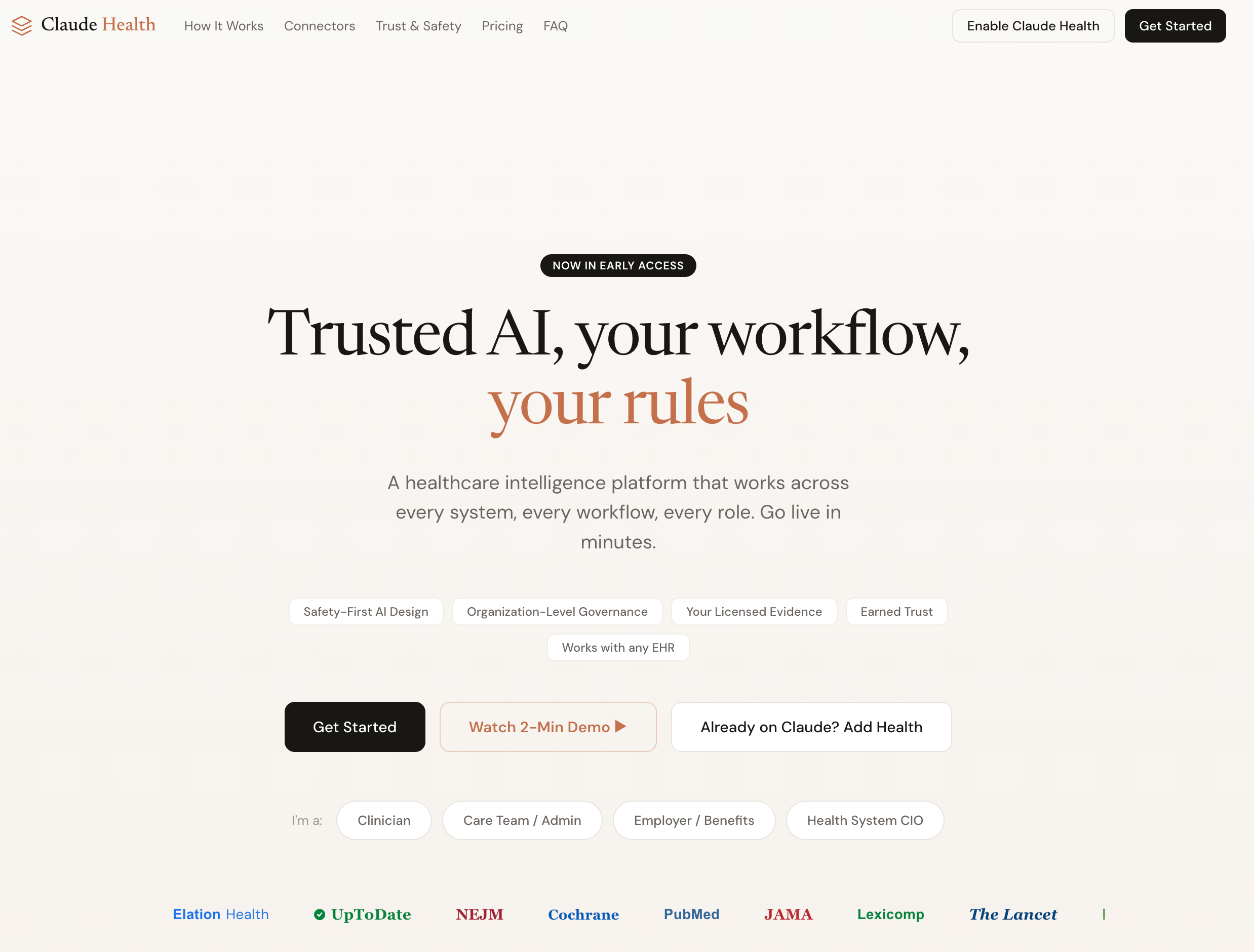
A mock, a playbook, and a plea from someone who’s spent 15 years building healthcare technology — with Claude’s help — about how AI could change everything. Spoiler: it’s not about the model, it’s the workflows.
Imagine a two-physician practice in rural Oklahoma, a clinic in São Paulo, or a hospital in Mumbai having the same AI tools that large health systems have. Intelligence that works across their existing systems, in their language, with their protocols. That’s what this is about.
TL;DR:
The browser is already an interoperability layer — the web was always designed to be
Partner with operators — build skills and earn trust together
Become the distribution layer for clinical evidence — it’s good for outcomes, it’s good business
Check out the Claude Health concept landing page I built with Claude to illustrate this → https://www.teoz.us/claude
The Browser Is Already an Interoperability Layer. The Web Was Always Designed to Be.
No six-figure, 12-month implementation. A handful of dollars per user, live in days. The web was designed as an interoperability layer — and every major healthcare system in the world runs on it. The deployment surface already exists.
Claude has a browser extension and a desktop app. Gemini and ChatGPT both have full browsers that read what’s on screen. Copilot is embedded in Edge and already integrated with Microsoft’s enterprise stack. All major EHR software is web-based: you’re already sitting on top of Epic, Cerner, Athena, NHS Spine, and hospital systems across Latin America and Asia — covering the vast majority of global healthcare without a single integration.
You just need to make it a fully compliant clinical workflow. Most of you are already HIPAA-compliant on the enterprise side. Extend that to the browser layer, include audit trails in the base product, and you have the universal deployment surface for healthcare AI. Globally. Clinicians will adopt this the way developers adopted AI coding tools — try it Tuesday, tell three colleagues Friday, pull through enterprise procurement from the inside.
And eventually the browser layer evolves from reading screens to reading data directly from structured EHR connectors, leaning on MCPs — many already available. But no need to wait for perfect interoperability to ship.
Partner with Operators. Build Skills and Earn Trust Together.
Trust is the product. Clinical leaders need to decide where and when to deploy AI, what safeguards to put in place, and when to increase autonomy. They need to manage their own quality assurance the way software teams do — audit trails, regression management, evaluation sets.
Organizations can also decide to share skills and evals, reducing the burden of maintaining them locally. When a cardiology practice in Cleveland builds a great eval set for HCC coding, that knowledge could flow back into the model — every practice benefits, and they also benefit from others’ knowledge. The AI companies that build this community create a flywheel that no single implementation can match.
Start with providers — access, capacity, cost, burnout, quality — the whole house is on fire, and clinician endorsement unlocks every other buyer:
Clinical Summary — synthesize the chart across encounters, flag contradictions, surface buried details. Lowest risk, highest immediate value.
Documentation & Coding — SOAP notes, ICD-10/CPT, HCC capture. Pays for itself through undercoding recovery.
Prior Authorization — cross-reference clinical records against coverage policies. $14B/year in physician time.
Then expand to the rest of the care team and operations:
Patient Communication — after-visit summaries at a reading level patients understand. Emergency red flags always included.
Care Coordination — referral summaries that don’t lose information. Population health flags for patients falling through cracks.
Benefits & Admin — coverage lookups, eligibility checks, claims routing, plan comparisons.
Over time, skills build on each other. Summaries feed documentation. Documentation feeds coding. Coding feeds prior auth. Each skill makes the next one smarter. The system that starts as a sidekick becomes the intelligence layer — and the EHR becomes data infrastructure underneath it.
Become the Distribution Layer for Clinical Evidence. It’s Good for Outcomes, It’s Good Business.
Clinicians want evidence at the point of care. They trust UpToDate, NEJM, ACC/AHA guidelines, Cochrane reviews. Publishers want distribution. Be the marketplace in the middle — negotiate volume licenses, bundle trusted sources, pass through at reasonable cost.
It’s a trust signal, a moat, and a revenue line. Good for patients, good for adoption, good for business.
Want to Make This Happen?
Especially if you’re in healthcare — does this match what you’d buy? What’s missing? What would you add to the playbook? Comment, share your perspective, and if this resonates, forward it to your favorite AI vendor :)
P.S. — I built a working concept with Claude to illustrate what this could look like → teoz.us/claude. Behind it, there’s more depth on sequencing, trust frameworks, and pricing than fits in 750 words. If you’re building something like this — the conversation is more interesting than the article.
All views are my own.